
学士
視点の移動によるモアレタイポグラフィの研究
ヴィジュアルコミュニケーションデザインスタジオ
#グラフィックデザイン#タイポグラフィデザイン#オプティカルアート
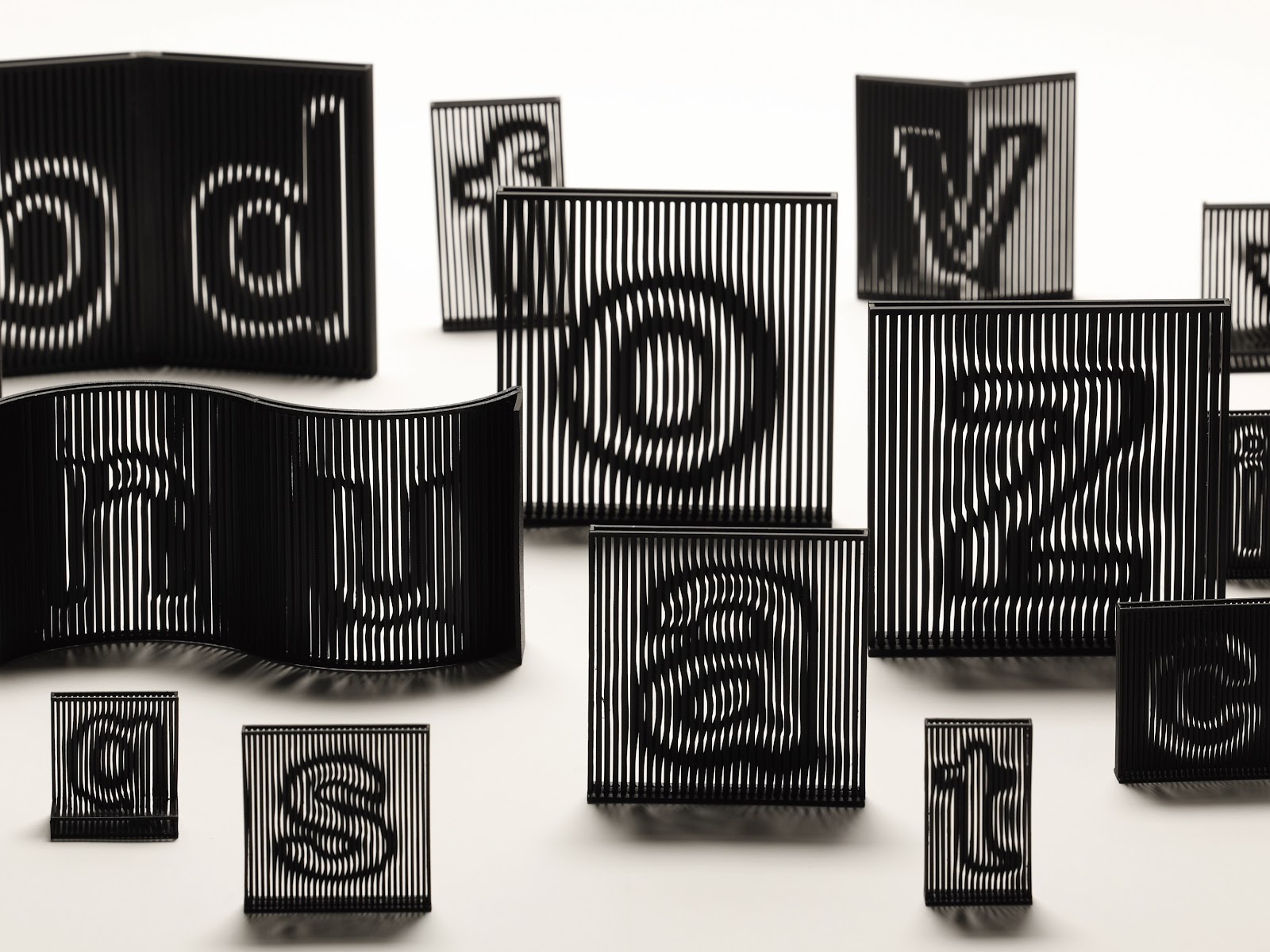
モアレの視差効果を用い、タイポグラフィを平面的な視覚情報ではなく、視点の移動によって成立する空間的な視覚体験として捉え直す。従来のタイポグラフィは主に「読む」「平面で見る」ことを前提としてきたが、縦線の重なりによって模様が生じるモアレ現象に着目し、視点の移動に応じて文字が揺らぎ、変化し続ける表現を構成した。
使用書体にはHelveticaを選択している。装飾性を抑えたニュートラルな構造を基準とすることで、モアレによる知覚の変化そのものを際立たせるためである。
制作は二つの展開で行っている。
ひとつは、3Dプリンターによる立体文字である。三つのスケールと五つの形のアプローチを設定し、同一の視覚原理のもとで文字の見え方がどのように変化するかを比較した。
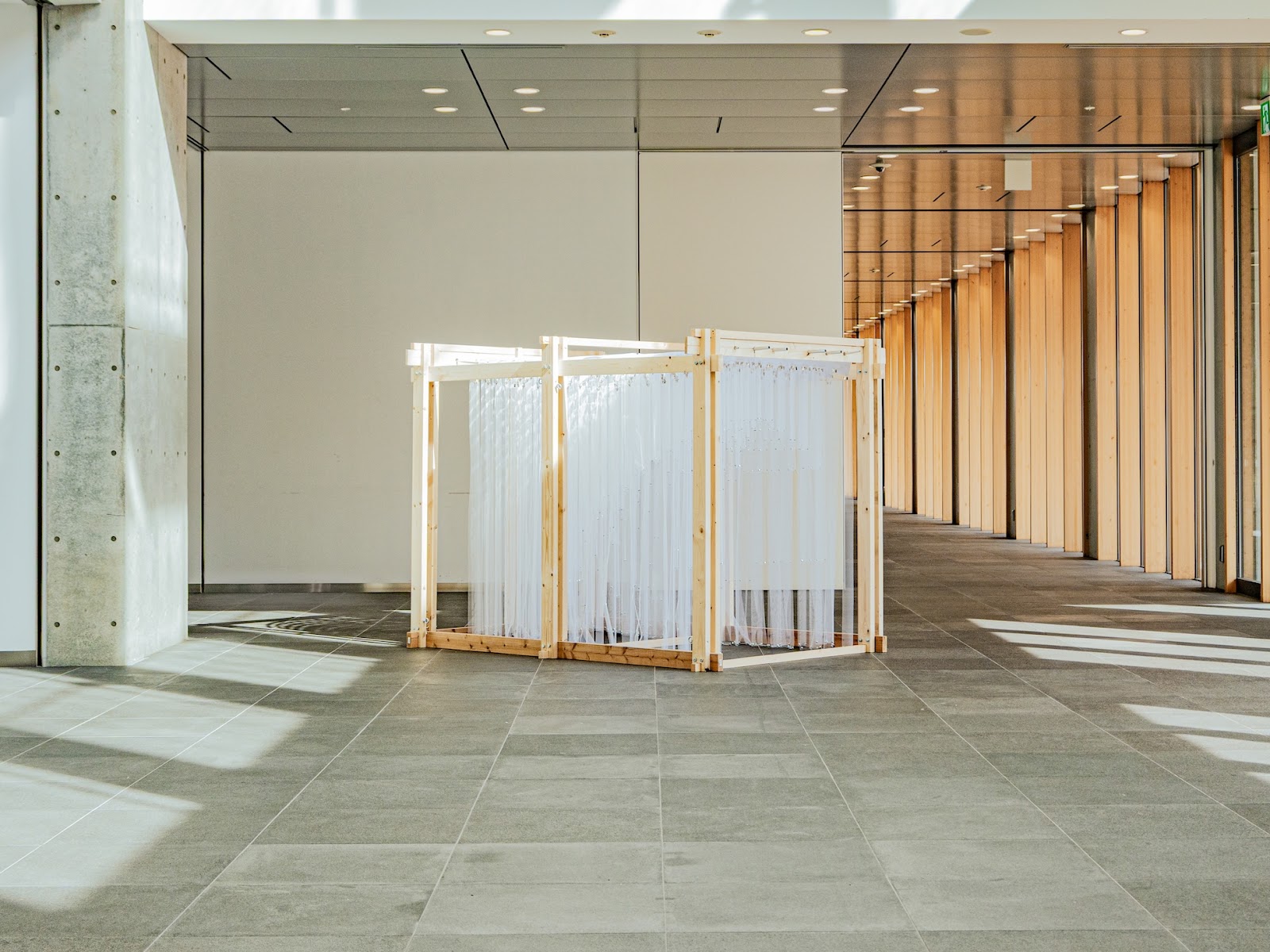
もうひとつは、すべてのアルファベットを含むパングラムを用いたアクリルパネルによる空間インスタレーションである。鑑賞者の移動とともに文字は像を結び、再び崩れていく。平面として存在していたタイポグラフィは、空間と身体の関係のなかで再構成される。
本研究は、文字の見え方を通して、身体性を含んだ視覚体験としてのグラフィック表現の可能性を探る試みである。
This project reconsiders typography not as flat visual information, but as a spatial visual experience that emerges through the movement of the viewer’s perspective. While conventional typography has been designed primarily to be read or viewed on a flat surface, this work focuses on the moiré phenomenon created by overlapping vertical lines. Through this optical effect, letters appear to fluctuate and continuously change as the viewer moves.
Helvetica was selected as the typeface for this project. By using a neutral and non-decorative structure, the perceptual changes caused by the moiré effect itself are emphasized rather than stylistic expression.
The project consists of two developments. One is a series of three-dimensional letters produced with a 3D printer. Three different scales and five formal approaches were established to compare how letterforms are perceived under the same visual principle.
The other is a spatial installation using acrylic panels arranged to form a pangram containing all letters of the alphabet. As viewers move through the space, letters emerge, dissolve, and reconfigure. Typography, which traditionally exists on a flat plane, is reconstructed through the relationship between space and the viewer’s body.
This research explores the potential of graphic expression through typography as a visual experience that incorporates physical movement.
Map
この作品は Gallery A : A38にてご覧いただけます。
この作品に関連した作品・研究
お気に入りの作品
© 2026 Department of Industrial Art, Tokyo Metropolitan University