
学士
スキャット歌唱の音色多様性に着目したピアノ音色の動的エフェクト制御
インタフェースデザインスタジオ
#インタラクティブアート#パフォーマンス#音響デザイン
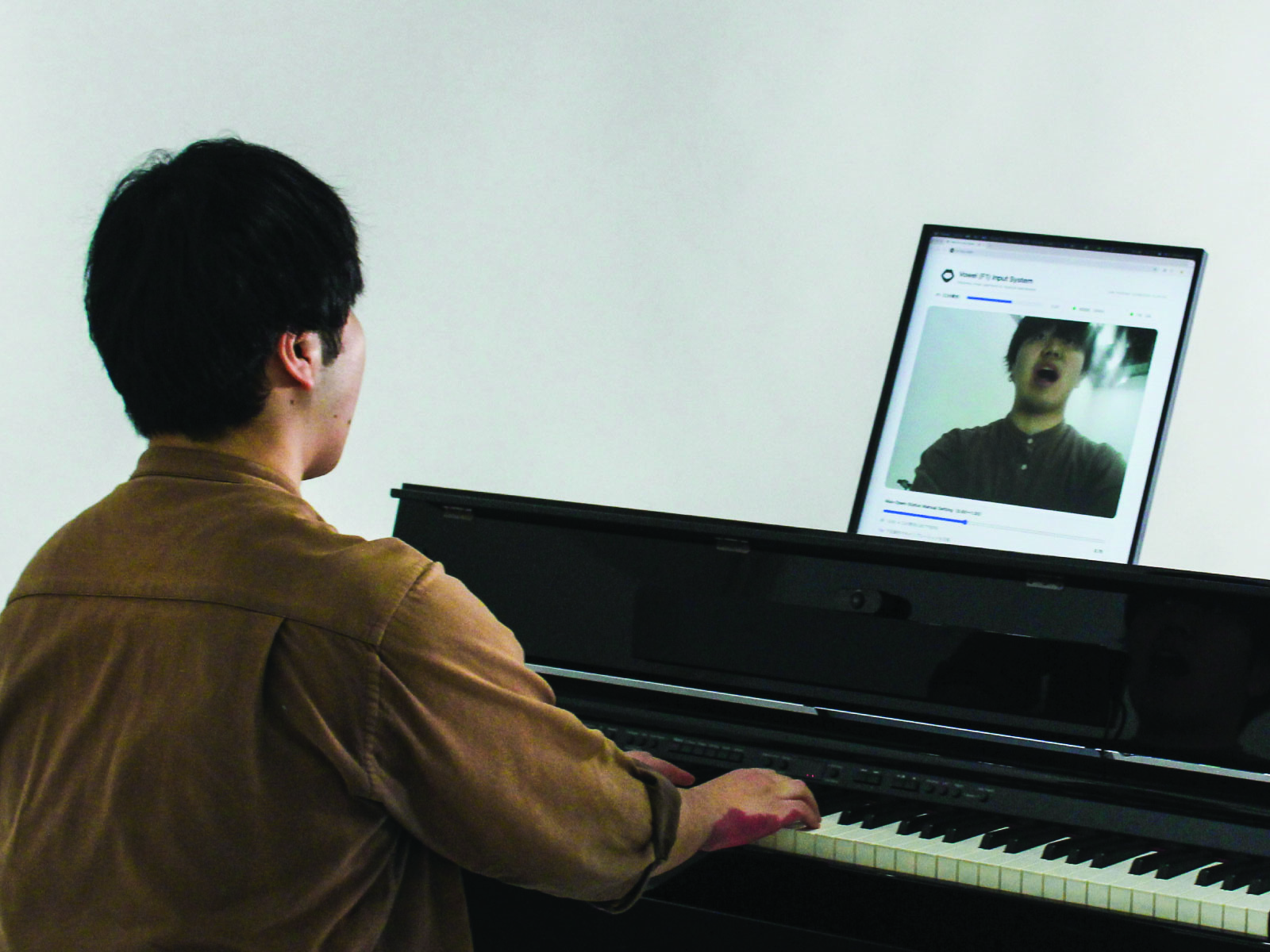
本作品は、アカペラとピアノという二つの音楽形態を横断的に編集し、歌唱中の身体的操作を楽器の音響表現へと接続するインタラクティブ作品である。アカペラ歌唱ではスキャットを用い、口の開閉や形状を意識的に作ることで音のニュアンスを操作する。本作ではその身体的操作に着目し、スキャット歌唱時の口の状態をウェブカメラでリアルタイムに取得し、ピアノ演奏におけるエフェクト制御のインプットとして用いる。
スキャットは「doo-bah」のように、意味を持たない音節を選択しながら母音を連続的に変化させる身体的な演奏行為である。本作では、こうした口の動きや母音の遷移を入力として用い、ピアノ音色に対するエフェクトの切り替えや変化量として反映させることで、作られた口の形から連想される声色のイメージに近いピアノ音色を生成・編集する。これは、ギター演奏などにおけるエフェクターの差し替えをピアノ演奏へと読み替え、その操作を足元ではなく口の動きによって行う試みであり、鑑賞者は演奏中に行われる操作と判断の連続として音楽体験を捉えることができる。
母音の連続性は口の開き(F1)と舌の位置(F2)によってマッピングすることができ、本制作ではF1値で表せる口の開き具合に着目している。口が閉じているときにはワウやフィルター、口が開いている時にはディストーションやディレイをかけることによって、口の大きさが作る声の響きに連動したピアノ音色を生成するよう試みた。
Scat singing in a cappella performance is characterized by the use of meaningless syllables, in which vocal timbre and nuance are shaped through bodily actions such as mouth opening, articulation, and continuous vowel transitions. In contrast, timbral variation in piano performance is often treated as a preconfigured or external process, separated from the performer’s bodily actions during performance.
In this project, an interactive system was developed to capture the degree of mouth opening during singing using a web camera and map this data in real time to effect parameters applied to an electronic piano. By focusing on the continuity of vowel articulation, multiple patterns of timbral change were designed to enable gradual and continuous transitions in piano sound.
Through experimental performances comparing different mapping patterns, the results indicate that timbral changes became perceptible as part of the performer’s bodily actions. The performer tended to recognize timbre control not as an external adjustment, but as an integrated component of musical performance.
Map
この作品は Gallery A : A16にてご覧いただけます。
この作品に関連した作品・研究
お気に入りの作品
© 2026 Department of Industrial Art, Tokyo Metropolitan University