
学士
近視者の視認性向上を目的とした特殊印刷表現の評価と設計
エルゴノミックデザインスタジオ
#UXデザイン#人間中心デザイン#ユニバーサルデザイン
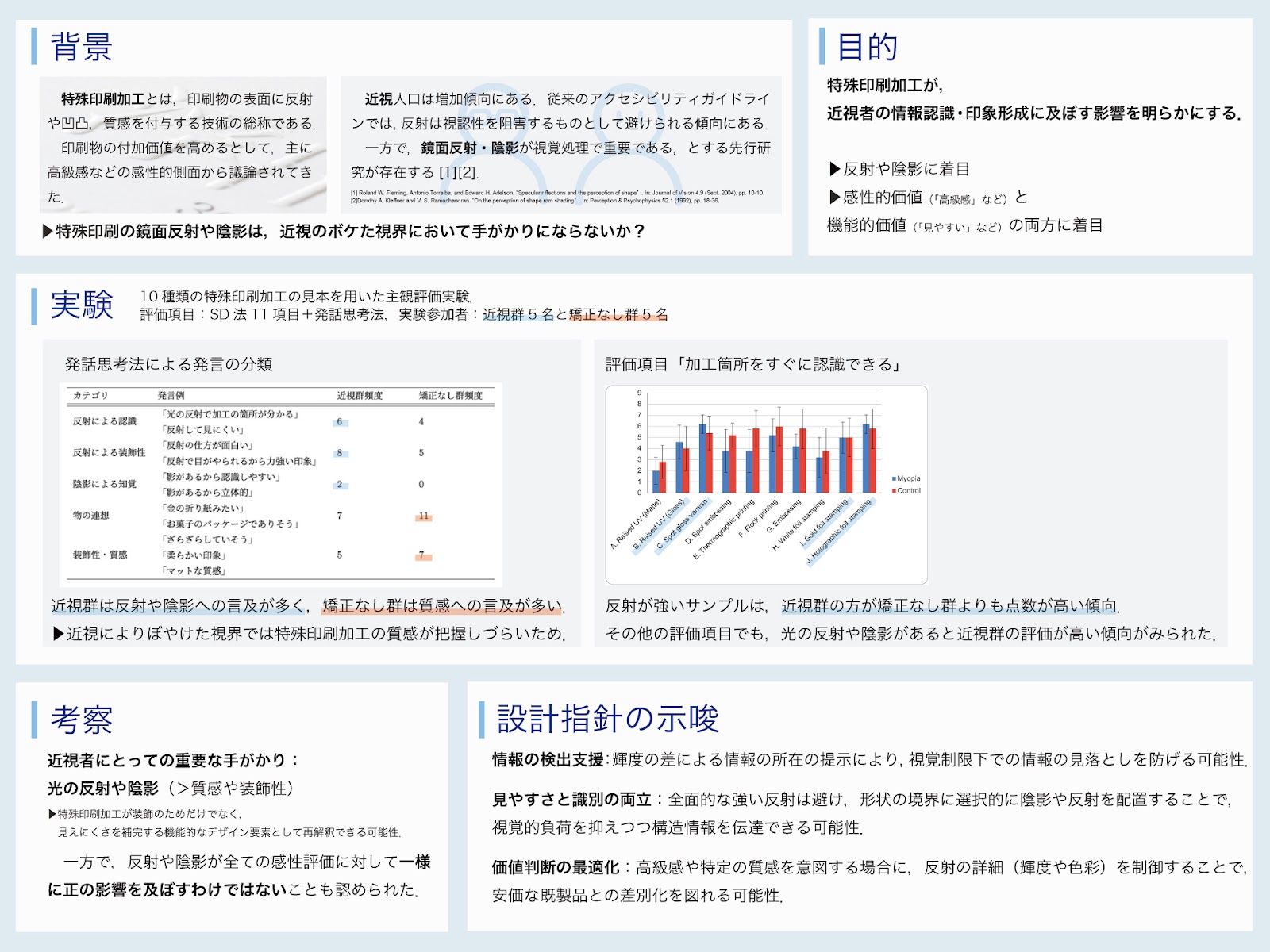
本研究の目的は、箔押しやエンボス、ニス引きなどの特殊印刷加工が、近視者の情報認識および印象形成に及ぼす影響を明らかにすることである。従来、特殊印刷は「高級感がある」などの感性的な付加価値を高める手法として扱われてきたが、本研究ではその視覚的特徴による機能的な価値(「加工箇所をすぐに認識できる」など)にも着目した。
その検証のため、異なる特殊印刷加工を施した10種類の印刷見本を用いて、近視者と正常視力者を対象に主観的な評価実験を実施した。結果として、近視が原因でぼやけた視界では、特殊印刷加工の質感や装飾性よりも、光の反射や陰影の方が、加工箇所を検知するための重要な手掛かりであり、かつ感性評価を左右するための重要な要因であることが明らかになった。
これらの知見から、特殊印刷加工は装飾のためだけでなく、近視者の見えにくさを補完する機能的なデザイン要素として再解釈できる可能性を持つことが示された。今後は、具体的な利用場面を想定したプロトタイプやUXマップの制作を通じて有効性を検証し、反射や陰影の特性を積極的に活かした新たなアクセシビリティの設計へ展開していきたい。
Special printing processes—a collective term for techniques such as foil stamping, embossing, and varnish coating—have traditionally been discussed primarily in terms of their Kansei value, such as conveying a sense of luxury. Meanwhile, ensuring visual accessibility has become a critical challenge due to the growing myopic population. However, existing guidelines tend to avoid reflections, treating them as factors that hinder visibility. In contrast, prior research suggests that specular reflections and shadows serve as essential cues for shape estimation.
This exploratory study aims to clarify how the visual characteristics of special printing processes influence information recognition and impression formation among individuals with myopia. Subjective evaluation experiments using a 7-point Semantic Differential (SD) method were conducted with 10 participants: 5 in the myopia group and 5 in the control group (individuals with vision sufficient for daily life). Ten types of printed samples were used as stimuli.
The results indicated that the myopia group tends to rely heavily on specular reflections and shadows for the recognition of special printing. Conversely, it was also confirmed that excessive reflection tends to decrease legibility. Furthermore, the findings suggested a correlation with Kansei evaluations, indicating that reflections and shadows may influence both functional and Kansei values.
These findings suggest that special printing processes can function not merely as decorative techniques but as functional elements that compensate for the visual difficulties experienced by individuals with myopia. By reframing reflections and shadows as cues that complement visual information, this study suggests new design guidelines for inclusive design.
Map
この作品は Gallery A : A25にてご覧いただけます。
この作品に関連した作品・研究
![皮膚型インターフェースによる生物的[ヒト-モノ]コミュニケーションの構築](https://lh3.googleusercontent.com/d/1N5xbr5HXHwl2rb_dzTkxgo_Dz8XGLvK1)
お気に入りの作品
© 2026 Department of Industrial Art, Tokyo Metropolitan University