
修士
水中気泡ディスプレイの多層化表現とシミュレーションシステムの構築
映像デザインスタジオ
#インターフェースデザイン#ヒューマンコンピュータインタラクション#インタラクションデザイン
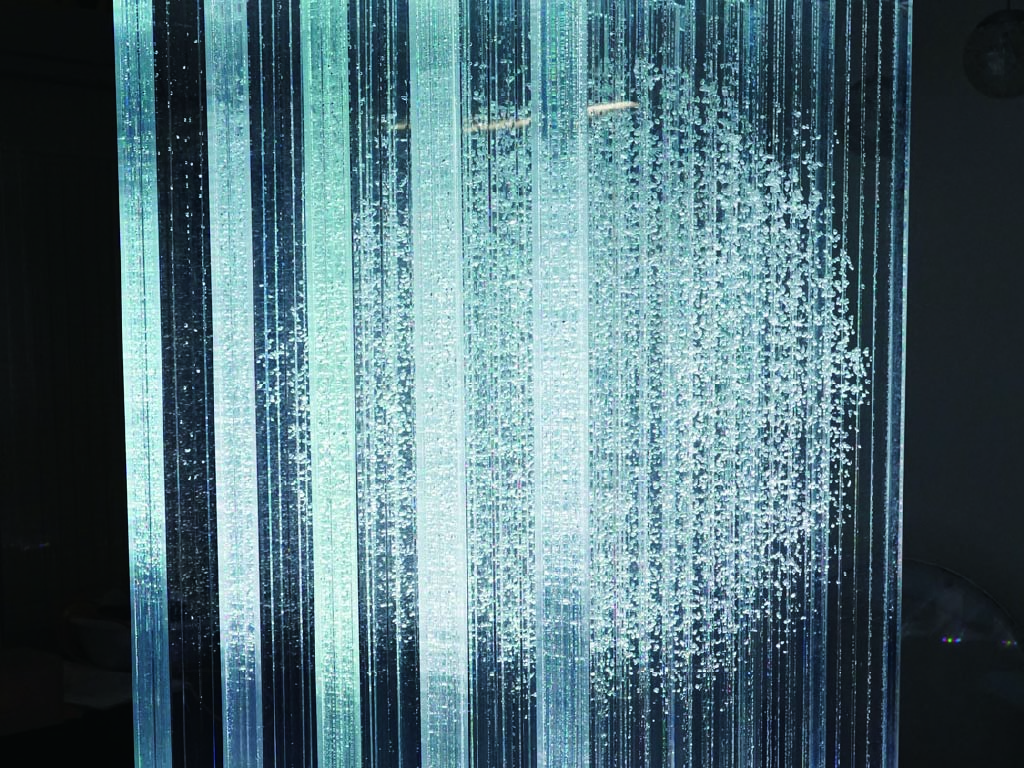
本研究は、水中気泡ディスプレイを対象に、多層化による立体表現の実現と、その設計を支援するシミュレーション基盤の構築を提案するものである。実体を用いたディスプレイは、物質の動きや変形を通じて情報を提示するため、映像投影にはない空間的実在性を備え、直感的な情報提示を可能にする。本研究では、透明性と流動性を持つ「水」を媒体とし、その奥行き方向への表現拡張を試みた。
研究の目的は、多層化による新たな立体表現の開拓と、実機依存の制作プロセスを効率化する設計支援環境の構築である。従来、水中気泡ディスプレイの制御信号生成は手作業に依存し、表現の確認も実機での試行錯誤を要するため、設計から調整までの時間的コストが大きな課題となっていた。
提案するシミュレーションシステムは、2D画像から生成した制御信号に基づき、3DCG上で完成状態を事前にプレビューするものである。入力画像をグリッド分割して気泡発生の有無を判定し、実機の制御周期に準じたラインスキャン方式で駆動信号へ変換する。生成された信号はシミュレーターと実機へ並列に送信され、物理的に妥当な気泡の挙動をリアルタイムに確認できる環境を実現した。
このシステムを応用し、3Dモデルを5枚の断面画像に分割して各層へ入力する手法により、5層構成の多層水中気泡ディスプレイを実装した。検証の結果、視差や遮蔽といった三次元的手がかりが明確に知覚され、従来の単層構成では困難であった奥行きのある立体表現を達成した。また、シミュレーションとの同期により設計結果の即時調整が可能となり、開発効率の大幅な向上を確認した。
今後は、システムのリアルタイム性を活かし、外部センサと連携したインタラクティブな表現への展開を目指す。身体動作に応じた気泡の動的制御により、水特有の触覚的性質と同期した多感覚的な空間メディアとしての応用が期待される。
This study proposes a multi-layered underwater bubble display and a simulation-based design environment. Unlike conventional digital displays, physical displays using tangible media provide a sense of spatial presence that is intuitively understood through the movement and deformation of objects. Leveraging the transparency of water, this research aims to achieve stereoscopic expressions with depth and dimensionality.
The research has two primary goals: realizing a three-dimensional visual expression through multi-layering and constructing a simulation system to streamline the traditionally hardware-dependent production process. Previously, designing bubble patterns required time-consuming trial and error on physical machines. The proposed simulation system addresses this by enabling real-time pre-visualization in a 3DCG environment, allowing designers to verify bubble behavior and visual overlaps before implementation.
Using this system, we implemented a five-layer prototype by slicing 3D models into depth-based cross-sections. The results confirmed that 3D cues such as parallax and occlusion were clearly perceivable, enabling complex stereoscopic expressions unattainable with single-layer configurations. Furthermore, the ability to synchronize the simulation with the actual hardware significantly improved development efficiency. Future work will explore interactive applications using external sensors to create multi-sensory experiences that synchronize human motion with the unique tactile and visual properties of water.
Map
この作品は Gallery B : B20にてご覧いただけます。
この作品に関連した作品・研究
お気に入りの作品
© 2026 Department of Industrial Art, Tokyo Metropolitan University